Two subjects, taught together
In the French system, physics and chemistry form a single subject, physique-chimie, from collège to the terminale specialty. At the brevet, the science paper draws on two of three disciplines — physics-chemistry, life and earth sciences, technology — chosen each session, so it pays to be ready for it.
Physics
The usual problem is not the formula but the modelling: deciding what is being asked, which quantities are available, and what the answer should look like before calculating. Students who leap straight to an equation get stuck the moment the question is phrased unfamiliarly.
Chemistry
Moles, concentrations, reactions and, later, organic chemistry. Much of the difficulty is bookkeeping: distinguishing a quantity from its symbol, tracking units through a calculation, and knowing which figure the question actually wants.
A worked example: units carry meaning
How many moles of water are there in a 180 g glass of water?
n = m / M = 180 g / 18 g mol⁻¹ = 10 mol
The arithmetic is trivial. Two things are not. First, the units: grams divided by grams per mole give moles, and checking that before calculating is what tells a student whether to divide or multiply. Second, the interpretation — ten moles is around six times ten to the power twenty-four molecules, an order of magnitude that explains why chemists count in moles at all.
In a lesson we make the student state what they are looking for and in which unit before calculating, then explain what the result means afterwards. The correction covers that whole path, not just the number.
Advanced-level work: mechanics, electricity, probability
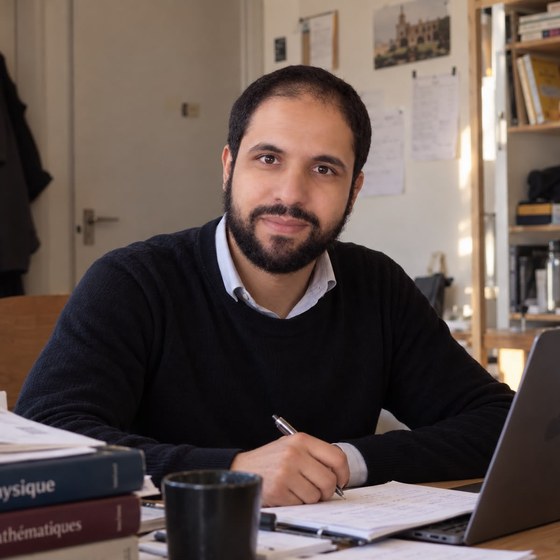
For students working at a higher level — the terminale specialty, preparatory classes or the start of university — questions usually combine several ideas at once rather than testing one formula in isolation. Abderrahman, who holds a PhD in physics, works specifically at that level, online: mechanics, electricity and the probability questions that turn up inside physics problems.
French curriculum and British syllabuses
The scope of French physique-chimie does not map cleanly onto IGCSE sciences or A-Level Physics and Chemistry. Practical write-ups, the weight given to the experimental method, and the expected level of mathematical treatment all differ. We match the tutor to the syllabus your child sits, and teach in the language they are examined in.